

Written by Torsa Ghosal
An edited version of this article was originally published by Saag Anthology in August 2025.
Since launching in 2006, Jaipur Literature Festival (JLF) has been repeatedly called the “Kumbh Mela” of literature festivals. Kumbh Mela is a Hindu religious event held every six to twelve years at the confluence of the three rivers, Ganga, Yamuna, and the mythical Saraswati, where devotees convene in numbers unmatched by any other religious gathering in the world.
The Kumbh analogy signals JLF’s massive scale and popularity. Indeed, the book festival is a mela, a social spectacle, that brings anywhere between three to five hundred speakers to Jaipur, shuttles them between the venue and the various four- and five-star hotels lodging them, swishes them off to party in the city’s gorgeous palaces and forts. 400,000 visitors and around 4000 vendors thronged the festival grounds in 2024, according to estimates.
Until recently, the staunch religious underpinnings of Kumbh had no direct equivalent in a festival branding itself as an international “literary show,” which hosted an assortment of luminaries such as Margaret Atwood, Orhan Pamuk, Kamila Shamsie, Oprah Winfrey, and the Dalai Lama. But over the last few decades, Hindu religious identity has increasingly defined national belonging and nationalist policies in India. This year’s Maha Kumbh Mela was attended by 4 times as many people as the previous iteration of the event, blazing proof of the upthrust in religious fervour among Indians and diasporic Hindus. JLF’s programming was not immune to the pulls of religious nationalism. The festival kept the crowds sated on pageantry and celebrations which often obscured the ways in which panels and talks questioned the nationalist agenda.
Supported by a SALT travel grant, I was at JLF to scout authors in my role as an acquiring editor for Kaya Press’s brand new South Asian imprint, Kulhar Books. Working with Kaya’s managing editor Neelanjana Banerjee and the rest of the Kaya team, Kulhar editors—Rajiv Mohabir, Jhani Randhawa, and I—aspire to publish stylistically and ethically-politically imaginative literature; works that unsettle formulaic expectations caging and sanitizing South Asian literary expressions in America.
*** Donate here to support Kulhar Books and our work to publish South Asian diasporic books.
My first afternoon at JLF I heard the British author Sheena Patel speak about her desire for “the now to be captured” in her writing rather than telling a “timeless story,” and in a similar vein, my intention was to get a sense of “the now” of the literary-cultural scene in South Asia, intuiting that the festival would offer some—even if narrow—opening into the ideas and themes dominating the space. Flipping through the festival program, I tried to locate sessions on literary writings from and about South Asia with a focus on contemporary translated literature and newer voices, a task that proved to be somewhat at odds with JLF’s broad-ranging, political establishment- and celebrity-friendly slate of events, a host of which staged flaccid conversations on Hindu mythology, Hindu national and political identities, excitement about the potentials of AI and digital technology, corporate and startup success, even wellness practices.
The festival has a “flashy, dazzling quality,” notes Mrinalina Chakravarty in her 2014 book, In Stereotype, as serious literary conversations routinely jostle with the starburst of socialites, celebrities, cricket and Bollywood icons vying for the spectators’ attention. At this year’s edition, social media influencers, Bollywood celebrities, and politicians predictably clinched the largest platform—the front lawn. UK’s former Prime Minister Rishi Sunak went viral for greeting the audience with folded hands in a “namaste,” obeying the nudges of an elderly woman whom Indian media variously identified as his mother and his aunt-in-law, while they were both attending Sunak’s mother-in-law and educator-philanthropist-billionaire Sudha Murthy’s talk in the lawn. A forty-five-minute session on that stage was allocated to politician and author Shashi Tharoor unpacking what it is to live as Shashi Tharoor.
Influencer Prajakta Koli blurted unprompted that her rom com novel contains “discrepancies” that she hoped readers would not pick up. In another panel at the same venue, Lucy Caldwell spoke eloquently and earnestly about her experience of writing short stories, learning to think of them not as plots but as moods, while festival co-director and author Namita Gokhale admitted she cannot tolerate reading her own short fiction and does not like to “go back and polish” them. JLF is often “a theatre of the absurd,” as Chakravarty observes, and the “incongruous juxtapositions of the bizarre and serious” raise questions about whether the festival coheres.
JLF does not cohere, and purposefully so. Vendors selling gorgeous brass jhumkas, wooden handicrafts, linen quilts and clothes form the backdrop of high-spirited debates and book launches. It is a carnival, almost in the Bakhtinian sense, a heteroglossia boasting of eclectic interests and priorities, but without the revolutionary zing Bakhtin associates with carnivalesque entertainment. JLF makes no pretence of renouncing hierarchies among speakers, vendors, volunteers, media persons, and spectators. There is a distinctly feudal quality to the “royal” warmth the green vest-wearing volunteers and interns shower on the invitees, riffing on the grand, luxurious image of Rajasthan in both the global and desi imagination. Rajasthan is after all the province where celebrities like Liz Hurley and Priyanka Chopra have hosted their weddings. Like crazy rich desi weddings, the happy hodge podge at JLF trades in stereotypes about South Asia’s mystique and splendor.
***
Over the years, JLF has stoked controversies around free speech, among other thorny issues, and such controversies, Amitav Ghosh points out, shows how literature has become “embedded within a wider culture of public spectacles and performances…overtaking, and indeed overwhelming writing itself as the primary end of a life in letters.” As far as frenzied public spectacles in India go, none in recent times can compete with the individual and collective performances of the Hindu religious identity at the Mahakumbh, and the book festival arena is a porous zone. The five-day programming at JLF, what speakers thought permissible to say or not say, the audience questions, the popularity of sessions were all rooted within a broader cultural sphere that in 2025 happened to be flooded with giant billboards starring tight-lipped smiles of India’s Prime Minister alongside his brother in arms, the ascetic-politician Chief Minister of Uttar Pradesh. Both their portraits were pasted onto scenes showing teeming millions on the banks of a river, coloured such a rich shade of blue that I can tell it has gone through layers of digital filters, if the raw photograph was ever of the muddied brown Ganges I have known and swam in. The hoardings carried taglines like “Message from Kumbh, The Nation Must Unify” and “Sanatan Pride, Maha Kumbh Edition.”
Desi internet was trending Kumbh news and memes, minting new viral heartthrobs—hot Sadhus and Sadhvis—through WhatsApp forwards and Instagram reels, plus supplying shock and cringe content, that I and surely other festival attendees dutifully consumed.
Young people are showing interest in scriptures, Malashri Lal remarked at a session launching mythologist Sunita Pant Bansal’s A Comprehensive Guide to Indian Scriptures. The slim book introduces Hindu sacred texts like the Puranas, Vedas, and the epics “as it is,” the author insisted, “without my opinion.” The aim is to demystify and correct beliefs about Hindu religious texts. Why, then, does the jacket say “Indian scriptures” rather than Hindu scriptures, a young audience member asked after admitting he was “nervous and worried” to raise the question. And if the book is on Hinduism, have texts from Nepal been included? The publisher Dipankar Mukherjee, who was also on stage, chivalrously swooped in to field the question, rationalizing that they were “trying to be somewhat politically correct to ensure the book reaches the right audience…Where they [the scriptures] started to become codified, recorded that’s part of current India.” He subsequently plugged the festival co-director William Dalrymple’s latest book, crediting Dalrymple for completing “half our work” tracing the influence of Indian traditions and philosophy on other cultures.
Mukherjee’s blithe verbal acrobatics for swapping Hindu with India not only aligns with the religion-nation nexus the country’s government has openly adopted in the last decade but also follows the money as it were. Writing for New York Times, Anupreeta Das claims that book festivals are all the rage among India’s youth. On the surface, the hipness of literary festivals bodes well. Das notes young people “are increasingly reading literature in their native tongues alongside books written in English. For these readers, books open worlds that India’s higher education system, with its focus on time-consuming preparation for make-or-break examinations, often does not.” But what are the young people reading in these various languages? What kinds of worlds are books unlocking? The answers are not straightforward.
*** Donate here to support Kulhar Books and our work to publish South Asian diasporic books.
Trapped in a long, slow-moving queue formed in front of a toilet in Amer Clarks, women were commiserating about the shortage of bathrooms at the venue and asking rhetorical questions about toilet occupants like “what’s taking them so long.” Interrupting this communal bonding over excretion, a woman in her early twenties started to hype up her own novel that retells the Hindu epic Ramayana. Ramayana has become something of a foundational text in the Hindu nationalist imagination. The woman pitching her retelling to a captive, pee-holding audience explained that her book followed the love story of the Hindu demigod Lakhsman whom “feminism” has unfairly sidelined. Her pithy spiel echoed a pervasive cultural sentiment wherein Hindu culture and Hindu Gods need constant protection from the evil eyes of liberals and heretics. Another young woman asked for the book’s title to order on Amazon before any of us had emptied our bladders. Some days later, while looking up the book, I stumbled upon the author’s public Instagram grid that featured side-by-side photos of her in JLF and at Mahakumbh. Completing the spiritual chic circuit of JLF-Mahakumbh she follows in the illustrious footsteps of others like Sudha Murty who took a holy dip at Kumbh days ahead of her JLF session.
That pop spirituality is booming in India can be inferred from the aisles of bookstores and catalogues of Indian publishers. OMTV, an “Indic storytelling” app, surveyed its users and found that around 80% of those consuming spiritual content are aged between 18 and 30. At the same time, The Crossword Bookstore on JLF festival grounds had eager customers crowding pretty much every corner, picking up new and old titles, not just the spirituality laced ones. And in an offline and online public sphere dominated by Maha Kumbh, JLF still managed to hold some conversations offering critical and nuanced perspectives on political Hinduism. But among the nearly three-hundred delegates, the festival included a handful of Indian Muslim speakers. Bollywood celebrities like the director Imtiaz Ali, Huma Qureshi, and Javed Akhtar were part of this roster. Mujibur Rehman who used a comparative framework drawn from histories of Black resistance to talk about the political marginalization and de-Islamization of Indian Muslims in Shikwa-e-Hind (2024) was challenged by a middle-aged, ostensibly Hindu, ponytailed thought leader among the audience. “I have lots of confusion about the premise of your book…Should we continue to call Muslims minorities with twenty percent population?” the man asked. Rehman told the man his book answers the question and supplemented his response with analogies underscoring how minority identity and minority rights are not simply pegged on numbers or even the success and visibility of a select few. India’s constitution despite its secular promises is inherently majoritarian, he argued, which informs the cultural landscape where Indians clapping at America’s flag do not invite suspicion, but an Indian Muslim boy clapping at Pakistan’s flag is interpreted as sedition.
***
Kashmiri Muslim, Pakistani, and Bangladeshi literary authors were largely absent from this edition. Sri Lanka found limited representation: Women’s Prize-winning novelist V.V Ganeshanathan spoke about the process of writing and researching for her novel, Brotherless Night, which is set during the decades-long civil war in Sri Lanka, and Maithree Wickramasinghe, the former first lady of Sri Lanka, launched her book of poems. Some absences can be blamed on logistics—Pakistan passport holders have immense difficulty procuring Indian visas at present, unless of course they are Maha Kumbh enthusiast Hindus. Then they are handed Indian visas swiftly. State rules force compliance but even state policies cannot explain all erasures. Theatre actor and director MK Raina who comes from a Kashmiri Pandit family spoke about owing his career to the state of Kashmir’s policy of allowing free education right from the 1940s, commented on inequities in contemporary India, and criticized the unrealistic portrayals of Kashmir in Bollywood. He left the stage when his co-panelist, the Rajasthani singer and thespian Ila Arun, started enacting a lengthy sequence from an Ibsen play she adapted and partly set in Kashmir, where a character “hurts the mother” and “hurts the motherland.” Raina’s abrupt departure was first interpreted as resulting from his frustration about the misrepresentation of Kashmir and later as following from his irritation with Ila Arun for hogging stage time. In any case, his absence didn’t dip the carnivalesque energy, and the panel concluded with Ila Arun belting her hit song “Resham ka Rumal” and the audience dancing along while simultaneously juggling smartphones obligated to record the tamasha.
Multiple sessions addressed Israel’s war on Gaza, but the sessions recycled a small group of speakers that included the Indian American author Pankaj Mishra, Palestinian author Selma Dabbagh, Pulitzer-winning American journalist Nathan Thrall, and Israeli British historian Avi Shlaim. The number of Arab authors featured were in low single digits. A JLF official reportedly interrupted an interview between the Press Trust of India and the Palestinian envoy to India Abed Elrazeg Abu Jazer on the grounds that the festival’s PR team hadn’t sanctioned it.
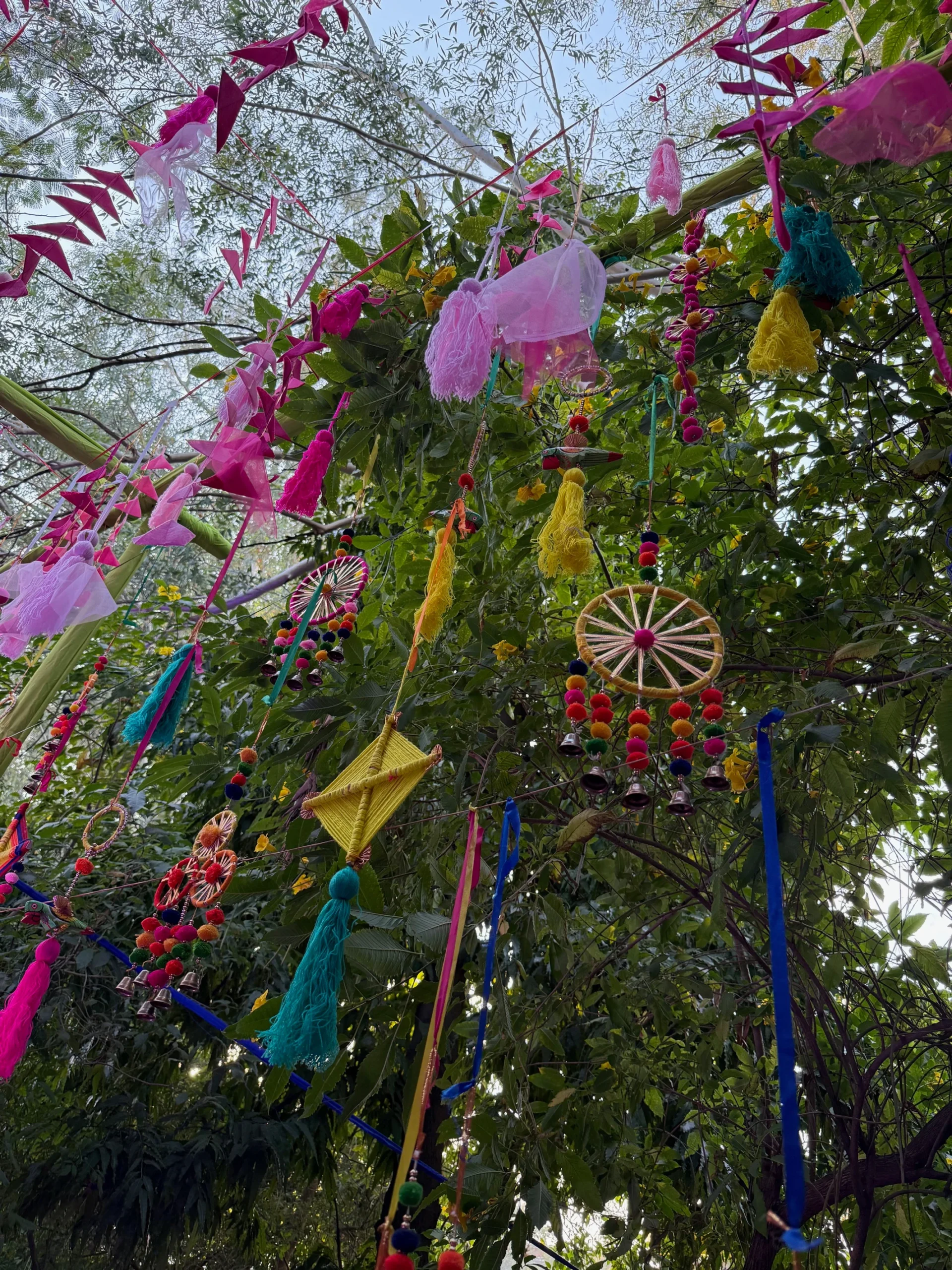
JLF’s speaker lineup suffers from issues common in invite-only prestige events. The curators turn to the same authors and cultural delegates year after year, and even each year, the same names reappear across sessions. The festival seems to be battling two opposing drives: an impulse to represent a diversity of relevant ideas and a desire to wring the most out of a trusted clique of speakers, resulting in conversations that sometimes feel repetitive, sometimes tokenistic. Although the festival is held in the state of Rajasthan and makes decorative use of Rajasthan’s crafts and colors to create Instagrammable corners, Rajasthani authors and Rajasthani literature are not at the forefront. Three panels, all held on the closing day, touched upon Rajasthani cultural traditions, one showcasing the book of Tripti Pandey, who also happens to be Ila Arun’s sibling, another on the region’s heritage, and the last one on oral and aural performances of Bhopas and Bhopis—regional priest-singers who narrate mythical episodes illustrated in traditional scroll paintings.
***
The consensus among the agents and editors with whom I spoke was translations are selling well in India. While the craft of translation was the core theme of only a couple of sessions, another bunch of panels incorporated discussions of translated literature and featured translators. Geetanjali Shree, who won the 2022 International Booker Prize for Tomb of Sand, translated from Hindi to English by Daisy Rockwell, spoke about her new novel on the opening day. Translator Arunava Sinha appeared on half dozen panels, including one in which he moderated a compelling conversation about the relationship of literature with truth and society between Anita Agnihotri, whose novels Sinha has translated from Bengali to English, and Saharu Nusaiba Kannanari, whose Kerala set English-language debut novel depicts the consequences of mob hysteria spreading through instant messaging.
A session held at the smaller venue of Jaipur Bookmark celebrated the Tamil publishing house Kalachuvadu which has printed creative and politically provocative writings—many of them translations—for thirty years now. Kannan Sundaram, who leads Kalachuvadu, also curated a session highlighting women editors and publishers transforming the Tamil publishing industry. Gayathri Ramasubramanian’s Zero Degree publishes translations and is named after a novel by the Tamil writer Charu Nivedita who contributed his entire oeuvre to the publishing house to support its growth. Ival Bharathi’s Nam Publishing offers a platform to poets who, she says with a smile, have been told their work wouldn’t sell. Nivedita Louis found a social media page “Her Stories” to carve a space exclusively for women writers before expanding into book publishing.
Despite conversations around translation, the translations launched and lauded at the festival such as Ten Indian Classics and The Phantom’s Howl often spotlit canonical or traditional literature. In The Phantom’s Howl, Arundhati Nath collects and translates ghost stories written by well-known and mostly upper-caste Bengali writers like Rabindranath Tagore, Bibhutibhushan Bandopadhyay, and so on. As a Bengali speaker and reader, I remember such stories charting the topos of my childhood, and I appreciate translations making them available to a wider audience. However, the continued emphasis on enduring, eminent, and the “timeless” at JLF leaves little room for emerging, radical voices.
The one panel showcasing works of four debut novelists—Anisha Lalvani, Rupleena Bose, Nayantara Violet Alva and Atharva Pandit—brought forth expressions of candor as the authors discussed their struggles to unscramble ideas and inspiration, balancing needs of the plot with style, before they arrived at the published versions of their manuscripts. Newer or debutant poets (except for the Instagram-famous Rithvik Singh) and short story writers didn’t receive a similar platform, in synch, I assume, with the marketplace percept that poetry and short stories don’t sell.
South Asian publishers seem wary of gambling on newer literary voices and styles which contrasts with the positions espoused by editors from Norway, France, and Germany. This is partly because in countries like Norway publishers receive greater support from their governments and cultural institutions. US-based agent Anna Ghosh discussed the corporate nature of major publishing houses in America, resonant with the Indian extensions of the same publishers, and distinguished the corporate model from university presses and independent presses in the US (which would include Kaya and Kulhar) that are informed by the personal tastes of editors.
The play-it-safe attitudes of the festival and South Asian publishing reflect, at least to a certain degree, the proclivities of South Asian readers who may also be unwilling to read unsettling voices from the region. “I only like foreign writers,” claimed the tuktuk driver who took the poet and translator Nashwa Nasreldin and me sightseeing through the old city. He insisted we call his vehicle “Ferrari,” vigorously rolling the r-s, and welcomed us to the ride with thick, heavy-duty night jasmine and rose garlands, a rather dramatic gesture rendering the “Atithi Devo Bhava” (A guest is like God) philosophy peddled in state-sanctioned tourism campaigns from the 2000s, revealingly titled “Incredible India.” Notwithstanding that I wasn’t a customer thirsting for magic and incredulity (neither was Nashwa), our “Ferrari” driver gladly exoticized himself, showed off his multilingualism, and as proof of his fluency in French, mentioned courting a long-distance French girlfriend alongside a local one. When I asked him if there are any Indian authors he admires, he shook his head and said he particularly hates Javed Akhtar and Shashi Tharoor. “They are elitist,” he complained, which is true, but they have also critiqued the Hindu nationalist project, which may or may not have anything to do with his detestation.
***
For the closing reception, speakers and other guests were shuttled to a stunning venue somewhere between Jaipur and Delhi that despite its name—Leela Palace—was not actually an old “palace.” It is a hotel popular for hosting destination weddings, I learned from the festival veterans with whom I ended up sharing a dinner table. The remoteness and lavishness of the hotel would make it the perfect setting for a season of The White Lotus.
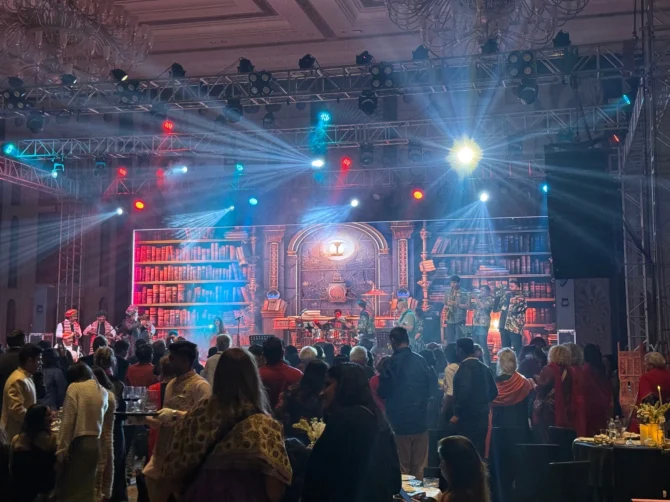
Rajasthani musician Chugge Khan and Princely States Dub Orchestra performed that evening—they sang standing against a screen printed with shelves holding colorful but nameless books, a vague reminder to attendees savouring the superb buffet and booze of the cultural commodity forming the beating heart of the spectacle. Although peppy, the music wasn’t quite amenable to dancing, but a committed segment of the audience swayed their hips and tapped their feet. Certain enraptured moves reminded me of the nagin dances staple at desi parties after a few drinks and high-on-faith Jagrata processions.
JLF is a shimmery tamasha that, like high-budget high-gloss Bollywood films, is fun to dip in so long as one is willing to forgo critical questions. The scale of the festival remains something to marvel at. But other literature festivals that have cropped up in India after Jaipur, such as the Kerala Literature Festival and Mizoram Literature Festival have made more emphatic attempts at grounding their events in their local cultures. JLF, on the other hand, is happy to remain the Chicken Tikka Masala of festivals, palatable to a wide-ranging, somewhat international audience, seemingly representative of South Asia, with a desi man and a Scottish one claiming credits for its origins.
—
Torsa Ghosal is the author of a book of literary criticism, Out of Mind (Ohio State University Press), and an experimental novella, Open Couplets (Yoda Press, India). Her fiction, essays, and interviews have appeared in Berkeley Fiction Review, Catapult, Los Angeles Review of Books, Literary Hub, Bustle, and elsewhere. She is an assistant professor of English at California State University, Sacramento, and a host of the Narrative for Social Justice podcast.
Leave a Comment
We'd love to know what you think.